

A thought occurred to me about the observations made by some fans that Miranda Hope’s single FU4That had been quietly replaced by an AI generated version. Both versions can be heard side by side in the shorts video below.
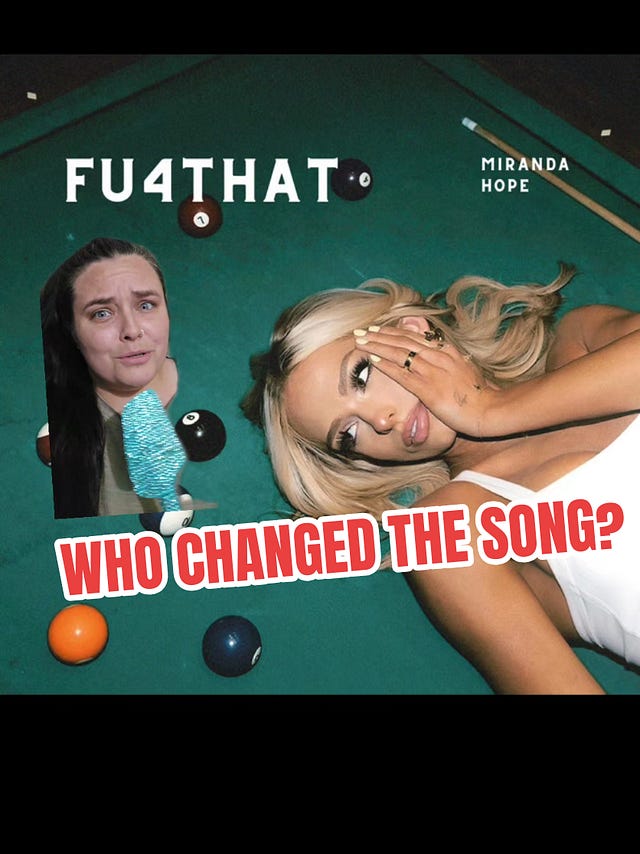
 Tiktok failed to load.
Enable 3rd party cookies or use another browser
While the change, from country pop to a slightly more aggressive pop song reminiscent of P!nk, bears some of the hallmarks of a remix, the changes in lyric and attitude go further than what most remixes have been historically able to do. Especially when the remix alters the melody and vocal tonality.
Given that Universal and collective rights agencies have been agreeing remix rights with Spotify that will usher in the fan made remix we can expect more of these sorts of observations to arise:
Universal and Spotify - https://newsroom.spotify.com/2026-05-21/universal-music-group-spotify-licensing-agreements-fan-made-covers-remixes/
Kobalt and Spotify - https://newsroom.spotify.com/2026-08-13/kobalt-spotify-licensing-agreements-fan-made-covers-remixes/
Merlin and Spotify - https://newsroom.spotify.com/2026-08-04/merlin-spotify-licensing-agreements-fan-made-covers-remixes/
While these remixes are meant to remain private, the fact of the matter is that many of these will make it out into the outside world. The AI remix of Miranda Hope’s single, assuming that’s what it is, has made it into the streaming royalty pool.
There are two things I find interesting about this example. The first is the difficulty for an entertainment process, the fan made remix, to remain behind its walled garden. I believe fans using this service will want to share their discoveries. By placing conditions on the material purely for private personal listening limits this desire to share.
The second point is that, somewhat like The Velvet Sundown, this could be the first of many breaching experiments. A way of testing the market, barriers and obstacles. I’ve written a few posts on this particular method:
50,000 AI Songs a Day: Why Fixing the Music Industry’s AI Problem Is Harder Than You Think

Every day, 50,000 AI-generated tracks are uploaded to Deezer. A recent survey conducted by Deezer and Ipsos found that 97% of listeners could not distinguish between human-made music and fully AI-generated tracks.
What’s quite difficult to know here is who are the actor’s behind this. There would have been a time before GenAI like Suno where the barrier to entry would be quite high. You would still need a range of expertise, musicians, writers, engineers, studio spaces and so on. While GenAI has potentially eradicated this barrier, it has also made it easier for experiments to be devised and run. As Andrew Frelon, the person behind The Velvet Sundown pointed out:
The whole thing took less than an hour and under $40 of AI subscription fees to put together all the songs, images, text, etc.
While we might trust that Miranda Hope’s single probably utilised a certain amount of human labour in its performance and production for the original release, the remix version is a different case. If, as some fans have pointed out that it’s AI, then it possibly falls into the same camp as the work undertaken by Frelon. What’s more, it may have taken very little time to do and at very little cost.
This brings me to my next observation. In a collection of short stories I wrote in 2022, one story, Public File - Access Trading, I imagined a scenario where a user could generate unlimited amounts of music where the songs were either:
songs either in imitation or in the style of
In essence they were derivatives but derivatives with a difference. In the story I imagined what it would be like to test interesting stylistic collisions between Nikki Minaj and Jacques Brel. What would that sound like given these specific inputs? Therefore, the software was more of a ‘what if’ engine rather than just an imitation engine. If you wanted to know what Jimi Hendrix and Miles Davis’ album would have sounded like had they been able to agree to work together, then the what if engine would be a vehicle capable of realising and refining such a fantastical proposition.
Remixes can also be considered as a creative form of derivative using as much or as little of the original to complete the work. Some remixes can be as successful as the original, like Tom’s Diner:
With the AI remix of Miranda Hope’s single there is of course another future. This is a future where a song like Hope’s when made by humans might be given to other teams working with AI to generate other potential versions of the song. This can be for different markets as much as trying to identify the definitive version to release. This means that the ‘best version’ might be human but could just as much be machine generated.
Michael Jones, in his book The Music Industries From Conception to Consumption, highlights that record labels have always over produced because this is one of the ways they manage risk. This is is also coupled with offsetting misses against hits. An AI remix version of Hope’s single in a more aggressive pop format could be an example of both over production and managing risk.
In a chapter I’ve written which will be published in 2027, I discuss the sorts of deals that might be possible where a user generates musical outputs using an artist’s vocal or musical dataset. I argued that an artist would have the choice to either get behind the project and re-record the song using their voice or endorse the AI generated version as an artist approved release.
If you recall songs like Eamon’s "Fuck It (I Don't Want You Back)"
Which was followed up Frankee’s spirited answerback:
There the potential for AI remixes to produce this sort of extendable narrative is one possibility. As was shown by Lil Nas X’s Old Town Road, there is the possibility to extend the lifecycle of a recording beyond the immediate release window. AI remixes, whether devised by fans or paid for teams, will give record labels the opportunity to manage over production and, maximise the potential for songs to be hits.
At the moment much debate centres around whether AI is music and how to detect it. But what happens when the record labels are making business based decisions on which version of a track to release: the human only, the machine only or the hybrid mix of human and AI?
Michael Jones also points out that record labels:
As companies, they focus their energies on controlling the marketing and distribution of the products they make rather than on how those products are originated – they exercise ‘loose control of symbol creators’.
By controlling the remix and derivative market, labels, once again, show their capacity to ride the choppy waters of technological innovation. It will be a record label’s choice to determine which version of a track is released. The artist might not have much choice at all. And, like John Seabrook’s account of Kelly Clarkson’s encounter with Clive Davis, Max Martin and Dr. Luke, the artist might not have much power at all. Any resistance they have might well result in their career stalling or failing completely.
As Clarkson recalled later, “I just think it’s funny that all these middle-aged guys told me, ‘You don’t know how a pop song needs to sound.’ I’m a twenty-three-year-old girl! But I was fighting those battles alone.” She added, “People can’t fathom that someone who is vocally talented could have some kind of writing ability.”
The problem that Clarkson experienced will be maximised in a time of AI. AI remixes of a track might gain traction sufficiently to displace the human version. It will be increasingly difficult for most artists to argue against labels undertaking this work because it sits within their domain of managing risk. Record labels aren’t along for the same ride as the artist. As Seabrook noted using a quote from Clive Davis’ autobiography:
“And all that attention affects all Idol winners. But then suddenly you’re in an entirely different world of making records in a studio, and you have to take direction. Kelly didn’t like it.” But Davis also knew that great vocal talents like Melissa Manchester and Taylor Dayne—both Arista artists—could have had much longer careers if they hadn’t insisted on writing their own material.
Davis’ final point regarding career longevity becomes one that can be experimented with in an AI system. An A&R person like Davis would almost certainly view AI as an opportunity to revisit artistic potential but this time performing the right material. There are examples of projects using dead popstars and musicians resurrected for an AI based project.
To be honest, Davis’ ego would’ve demanded it because then he would be proved right. At all points the artist must lose because they cannot be allowed to win.
Interesting aesthetic remix interventions, such as Verve Remixed, will potentially become a more frequent product within these AI derivative systems. These will give record labels ample opportunities to maximise their licensing catalogue opportunities. Many of these will be helmed by A&R teams perhaps with very flittle producer and/or artist involvement. Again examples exist such as a number of songs adapted for Hollywood trailers like Pink Floyd’s Eclipse, from Dark Side of the Moon, used in the Dune trailer.
Whether anyone agrees or disagrees with the AI remix approach or not is irrelevant. It part of the function of a record label. As I discuss with my first year business students on the subject of intellectual property rights:
The most powerful property rights are exclusive rights
In this context exclusive means the owner can exercise a right in relation to that property to the exclusion of all other people
Record labels are large owners of exclusive property rights. An AI remix and derivative system gives them the opportunity to extract value from their property rights. Rather than waiting for a customer to come to them and begin the negotiating process, in an AI system these rights and fees are agreed in advance, while every new version will remain under the ownership of the rights holder, thereby growing their catalogue.
If there is a potential downside then it will be in the world of cover tunes. Every remix or mashup made on Spotify will generate small amounts of revenue for the rights holders, publishing and recording, but there’s currently little incentive for the remix to be shared outside of Spotify’s walled garden. The AI remixes will probably function similarly to a cover version but not necessarily with as strong a creative approach. For example, Johnny Cash’s version of Nine Inch Nails Hurt is a good example of reimagining in a way that produces a new reading of the track.
Likewise, Ki:Theory’s version of Stand By Me which has been used on many shows including Fear The Walking Dead
For AI to function in this space it will require significantly more effort and focus to deliver a reinterpretation cover of sufficient power and depth.
For artists, the question is really twofold. The degree to which they are able to exercise any control of how most of this work takes place is debatable. Labels like UMG have assured that artists will have some moral right of objection but the distance between an economic work and the artist’s feeling has already been outlined by Clive Davis. The second point is that systems like AI, that use artists as inputs and training data, whether generating original songs for users or remixes, renders all artists as playthings. This is clearer in the remix system where the goals are play and discovery.